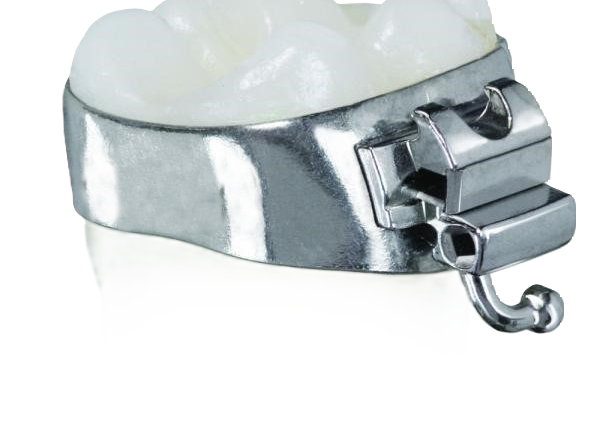
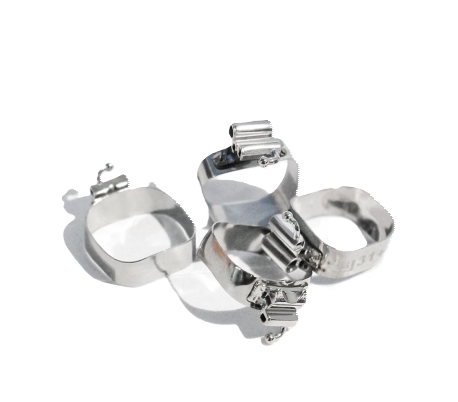
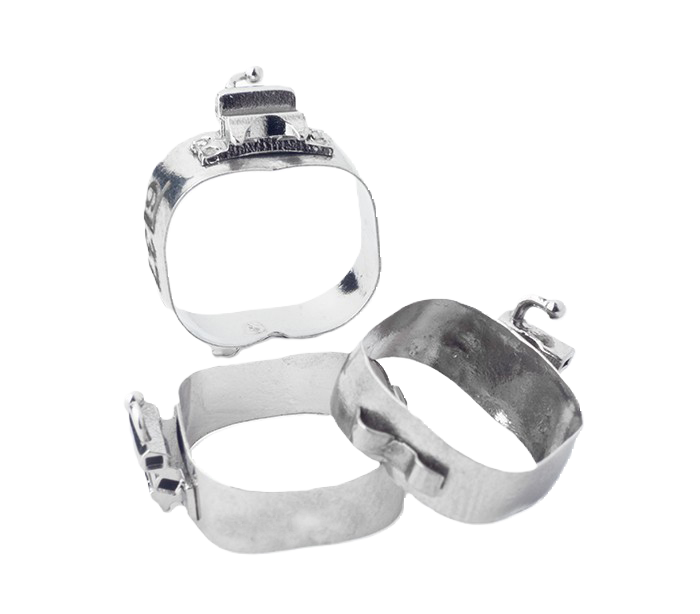
An orthodontic band is a thin metal ring that fits around a tooth (usually molars or premolars) and serves as a base for attaching brackets, tubes, or other orthodontic appliances.
Features:
Usually made of stainless steel.
The inner surface may have grooves or adhesive to hold a bracket or tube.
Size and shape are selected according to the patient’s tooth.
Molar Band:
Designed for large and strong molars.
High resistance to pulling and rotational forces.
Often used as a base for buccal tubes and auxiliary appliances.
Premolar Band:
Smaller and narrower than molar bands.
Used to hold wires and sometimes special brackets.
Anterior Bands:
Rarely used and mainly for holding special orthodontic appliances on front teeth.
Conventional Band:
Metal, uncoated, with inner grooves for a bracket or tube.
Most common type for classic orthodontic treatment.
Welded Band:
Used to attach auxiliary components such as special tubes or ceramic holders.
Coated Band:
Nickel- or tooth-colored coating for aesthetics and to reduce visibility of metal.
Functional Band:
Used for installing auxiliary appliances such as expanders or headgear.
Size: Should fit snugly—not too tight or too loose.
Strength: Must withstand the pulling and twisting forces of wires and appliances.
Coating & Allergy: Some patients are sensitive to nickel, so nickel-free or coated bands are recommended.
Adhesion: If a bracket or tube is needed, the inner groove or adhesive should be suitable.
Select a band of the appropriate size.
Trial fit on the tooth.
Use temporary wiring or adhesive for placement.
Permanent placement with cement or adhesive.
Check stability and patient comfort.