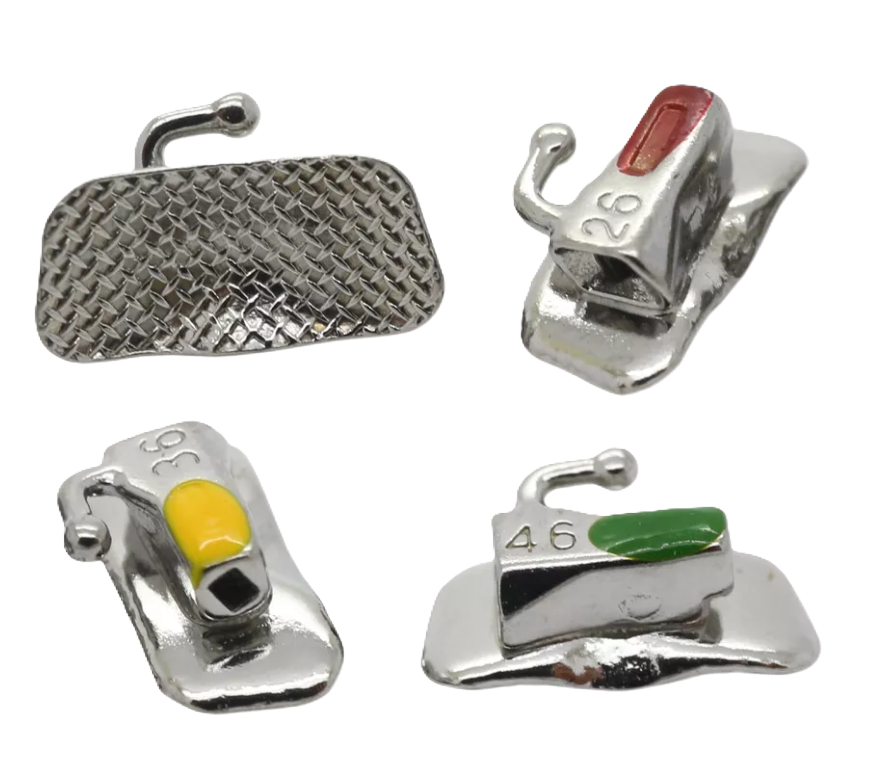
Buccal tubes are small, cylindrical metal components placed on the buccal (outer) surface of molar teeth during orthodontic treatment. They play a critical role by serving as a channel and anchorage for archwires, auxiliaries, and orthodontic force systems.
Band-Mounted Buccal Tubes:
The tube is welded to an orthodontic band that encircles the molar. This provides excellent stability and is often used in complex treatments.
Bondable Buccal Tubes:
The tube is directly bonded to the buccal surface of the molar using composite adhesive. This method saves time, increases patient comfort, and is common in modern orthodontics.
Slot: The channel where the archwire is inserted and guided.
Hook: Used for attaching elastics or auxiliaries like springs.
Auxiliary Slots: Present in certain designs for additional appliances.
Base: The surface that is either welded to the band or bonded directly to the tooth.
Single Tube: Contains one main slot for the archwire.
Double Tube: Includes a main slot plus an auxiliary slot for attachments.
Triple Tube: Features three slots for advanced appliance systems.
Convertible Buccal Tubes: Initially function as a closed tube but can be converted into a bracket when needed.
Commonly made of medical-grade stainless steel for durability, strength, and biocompatibility.
Designed to minimize irritation to soft tissues, ensuring greater comfort during speech and mastication.
Holding and guiding the archwire at the end of the dental arch.
Anchoring auxiliaries such as elastics, headgear, and orthodontic springs.
Delivering precise forces to control molar movements in various directions (mesiodistal, buccolingual).
Enhancing overall stability of the orthodontic appliance system.
Provides strong anchorage and stability.
Allows the use of multiple auxiliaries.
Increases precision in force application.
Modern designs improve patient comfort.
May cause cheek irritation during the initial days.
Requires replacement or rebonding if it loosens or detaches.
Bondable types are more prone to debonding compared to band-mounted ones.